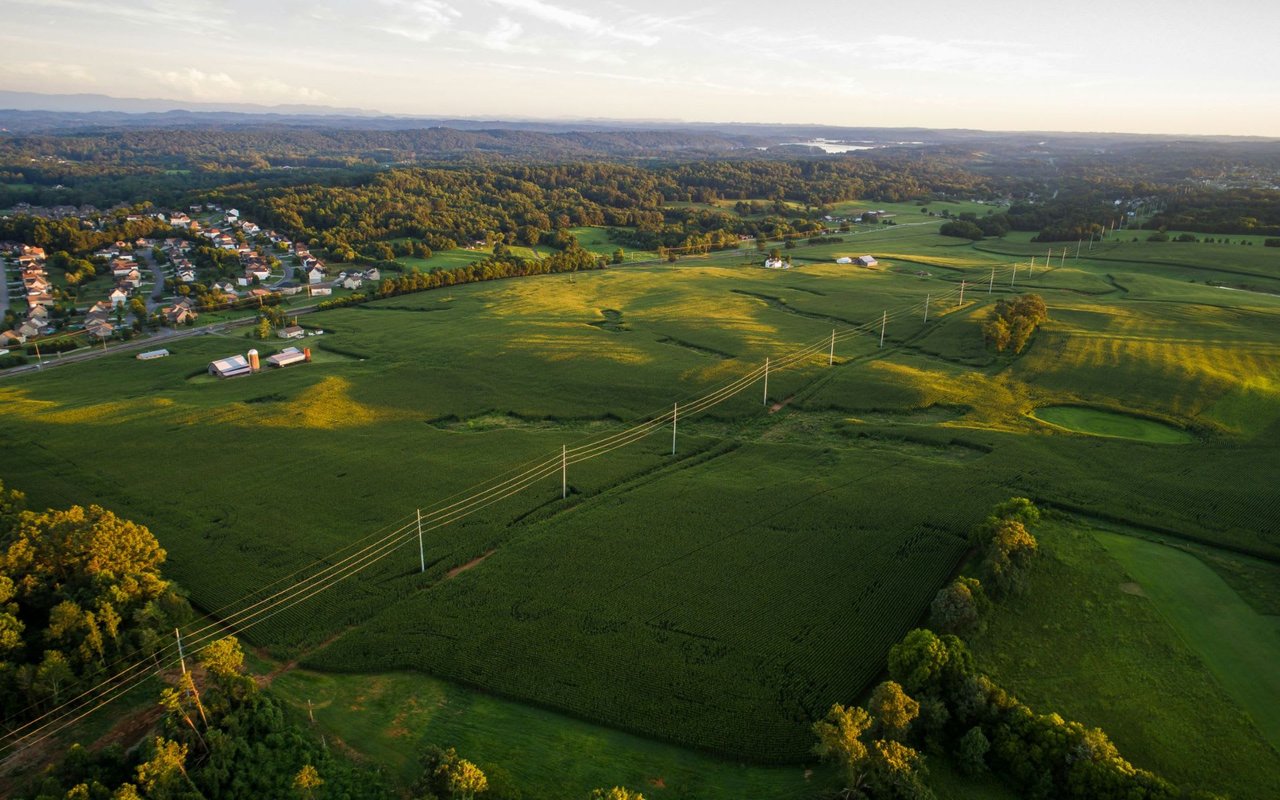
At the northeast corner of Thunderhead Road and Boardwalk Boulevard, across Thunderhead from Northshore Elementary School, sits a 4.1-acre parcel with no street address yet. University Health System, Inc. owns it. On September 1, 2026, its applicant company, UT Medical Center at Northshore, LLC, filed with the state to build a four-story, 60-bed hospital there, at a projected cost of $204,290,975. The site is in ZIP code 37922, the same ZIP as Gettysvue.
The Tennessee Health Facilities Commission's own staff review found that the proposal does not meet the state's test for new hospital beds. Under that formula, Knox, Blount and Loudon counties together have 479 more licensed acute care beds than they need. Hospitals in the same counties also report running close to full. Both statements are true because the bed count and the capacity to treat patients have drifted apart.
What UT Has Proposed for Thunderhead Road
The application is in the state's staff review of project CN2608-018. It describes a standalone hospital licensed separately from the main UT Medical Center campus, with about 171,168 square feet across four floors:
- Ground floor: a 14-room emergency department with one trauma room, inpatient and outpatient imaging, dietary services and radiation therapy
- Second floor: 8 operating rooms, 3 pre- and post-operative rooms, 2 cardiac catheterization labs, a clinical laboratory and a pharmacy
- Third and fourth floors: 30 medical and surgical beds on each
- Roof: no helipad
Imaging would include MRI, CT, X-ray, ultrasound, mammography and bone density testing. The cath labs would handle diagnostic and selected lower-acuity therapeutic procedures. Higher-acuity heart cases, trauma and high-risk surgery would still go to the main UTMC campus, which has open heart surgery capability. The design is a community hospital for the work that makes up most of a typical hospital's volume. Complex cases would still go downtown.
If approved, UT projects the hospital would open in May 2030. The largest cost items are construction at $129,316,219 and movable equipment at $31,663,957.
The State's Formula Measures Licenses
Tennessee's acute care bed standard projects need four years ahead using hospital utilization reports and state population projections, county by county. Applied to Knox, Blount and Loudon counties, it produced a surplus of 479 licensed beds and 103 staffed beds. Loudon County was the only one of the three to show a need under the formula, and that need was 7 staffed beds.
The 479 figure counts every bed a hospital holds a license for. A licensed bed is permission. A staffed bed has nurses, equipment and a budget behind it. When the formula switches from licensed beds to staffed beds, the regional surplus falls from 479 to 103, so about four of every five "extra" beds exist only on a license.
Where the Gap Shows Up
The staff review points to the two counties south of Gettysvue, each of which has one hospital. These are 2024 figures:
| County |
Licensed beds, 2024 |
Staffed beds, 2024 |
Share actually staffed |
| Blount |
304 |
146 |
About 48% |
| Loudon |
50 |
30 |
60% |
Blount County's hospital staffed fewer than half of its licensed beds in 2024. The same pressure shows up in the occupancy figures. Fort Loudoun Medical Center reported 92% staffed occupancy in 2023, and Tennova Healthcare North Knoxville reported 84%. A hospital at 92% of its staffed beds has very little room for a bad flu week.
The occupancy debate turns on one detail. UT's application puts average staffed-bed occupancy across all hospitals in the three counties at 81% for 2024 and 79% for 2023, which averages to the 80% threshold the state uses as an exception to the formula. State staff rejected that figure because it counts observation beds, which are not appropriate for this analysis. Without them, staff found that the area's hospitals did not exceed 80% staffed occupancy for two years in a row.
On both counts, the region sits close to the line where hospitals are considered full, even though its licenses show plenty of room.
Adding Beds and Building a New Hospital Follow Different Rules
State law adds another twist. According to the commission's staff review, statutory changes under Public Chapter 557, effective October 1, 2021, mean hospitals no longer need a certificate of need to add beds within existing bed type categories. The proposal at Thunderhead Road is for a new hospital, and that is the step UT has brought to the commission for approval.
UT's application argues that the formula is the wrong test for that reason. It says the bed criteria mainly address adding beds to an existing hospital, while this proposal would bring a full range of inpatient and outpatient services closer to where people live. It also cites shorter trips for patients in West Knox County, North Blount County and East Loudon County, plus relief for crowded hospitals, including UTMC itself. To the extent some patients would shift from the main campus, the application calls that an internal redistribution of UT's own demand to a more convenient location, not duplication.
The application also includes letters of support from Knox County Mayor Glenn Jacobs, Knoxville Mayor Indya Kincannon, Knox County Schools Superintendent Dr. Jon Rysewyk, Lt. Governor Randy McNally, U.S. Congressman Tim Burchett, and both of Tennessee's U.S. senators, among others, according to the support letter packet filed with the commission.
Hospitals Near the Site Today
UT's case rests on location, so the useful comparison is which hospitals are already within driving distance of the site. The staff review lists road miles from the proposed site to each hospital in and around the service area:
- Tennova Healthcare Turkey Creek Medical Center, 6.7 miles
- Parkwest Medical Center, 7.9 miles
- Fort Sanders Regional Medical Center, 11.5 miles
- Blount County's hospital, operated by Prisma Health, 14.2 miles
- The University of Tennessee Medical Center, 15.7 miles
- Fort Loudoun Medical Center, 16.6 miles
- Tennova Healthcare North Knoxville, 22.7 miles
The proposed hospital's service area covers 11 ZIP codes: 37909, 37919, 37921, 37922, 37923, 37931, 37932 and 37934 in west Knox County, 37737 and 37777 in northwest Blount County, and 37772 in northeast Loudon County. Gettysvue's 37922 is on that list.
UT already has outpatient practices in that area, including Rocky Hill Family Physicians, UT Internal Medicine–Pellissippi, UT Medical–Lenoir City and UT Primary Care Alcoa. The application says the new hospital would work alongside them. It also says UT does not plan to move any service lines from the main campus to Northshore.
Not Every Part of the Proposal Clears the State's Bar
The bed formula is not the only standard the staff review measured. Cardiac catheterization met all applicable criteria. Radiation therapy met the first-year volume standard but not the third-year one. UT projects 6,000 treatments per linear accelerator in 2032, against a state minimum of 6,323, or 94.9% of the threshold.
The commission took up CN2608-018 at its October 28, 2026 meeting, and it was not on the consent calendar. The commission's monthly meeting information page keeps the agenda and application materials, and its minutes go there once posted. Even with approval, May 2030 is the earliest projected opening, about three and a half years from now.
What This Means If You're Weighing Gettysvue
Families comparing Gettysvue with other West Knoxville or Tellico Lake communities often treat hospital access as a fixed fact about a location. This filing shows that it isn't fixed. How close care is depends on beds actually staffed, and that number can change faster than any license count. For a buyer closing this winter, the hospitals within reach are the ones on the list above. The Thunderhead Road hospital is a proposal for 2030 that still depends on the state's decision.
The capacity behind those hospitals is tighter than the licenses suggest. Occupancy sits near the 80% line, and the single-hospital counties of Blount and Loudon staffed well under their licensed beds in 2024.
Frequently Asked Questions
Would the Northshore hospital have an emergency room?
Yes, as proposed. The plan includes a 14-room emergency department with one trauma room. Trauma cases and high-risk surgery would still be handled at the main UT Medical Center campus, and the building would not have a helipad.
Which hospitals are closest to the proposed site now?
Tennova Healthcare Turkey Creek Medical Center at 6.7 miles and Parkwest Medical Center at 7.9 miles, based on the distance table in the state's staff review.
Where can I follow the state's decision?
The Tennessee Health Facilities Commission posts agendas, application materials and minutes on its monthly meeting information page. The application's project number is CN2608-018.
If you're relocating to the Knoxville area and nearby medical care is on your must-have list, I can help you look at how each West Knoxville and Tellico Lake community sits relative to the hospitals and UT practices operating today, and keep an eye on how the Northshore proposal moves forward. Liza Acheson works with long-distance and 55+ buyers on exactly this kind of detail. Request your free concierge consultation.